

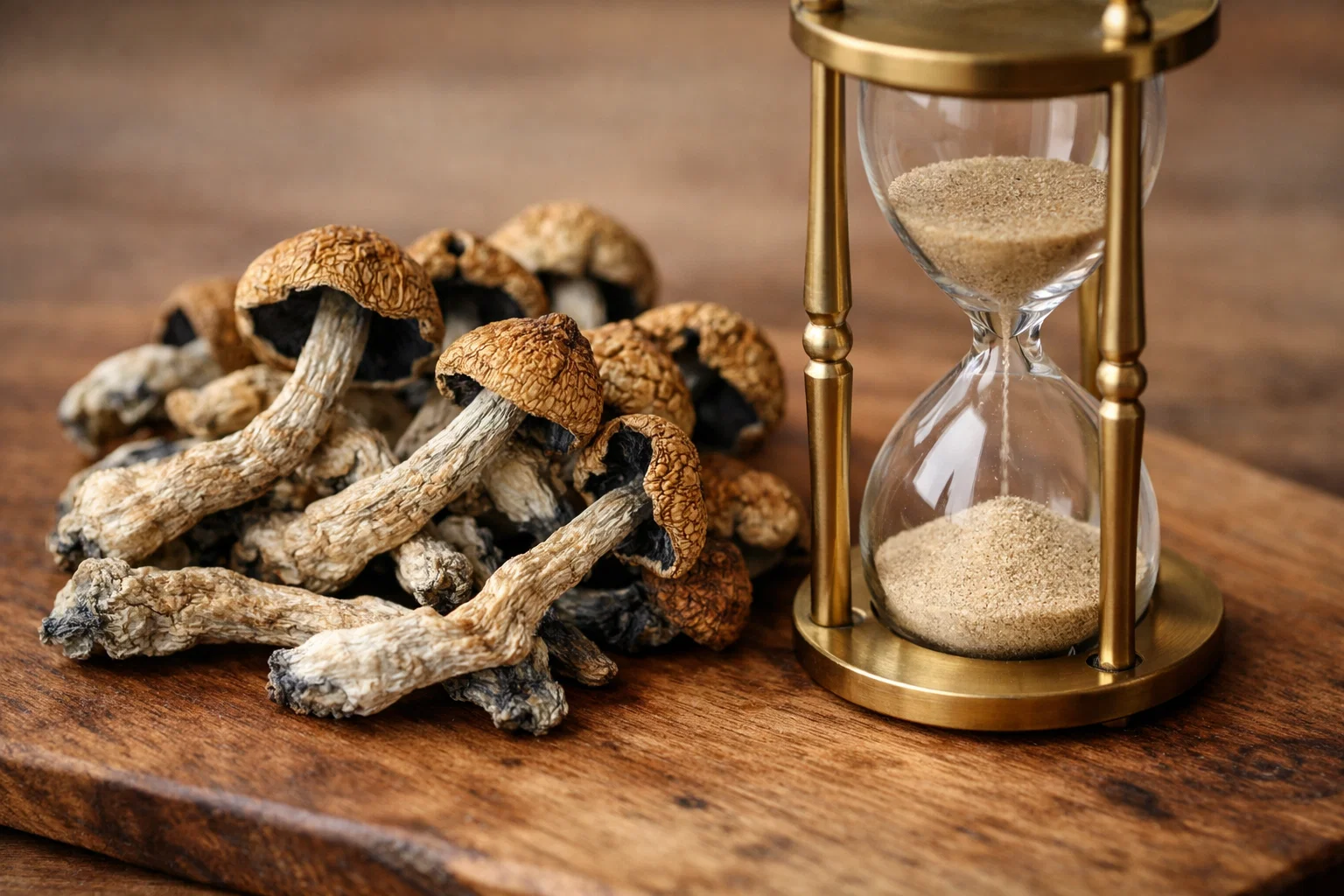
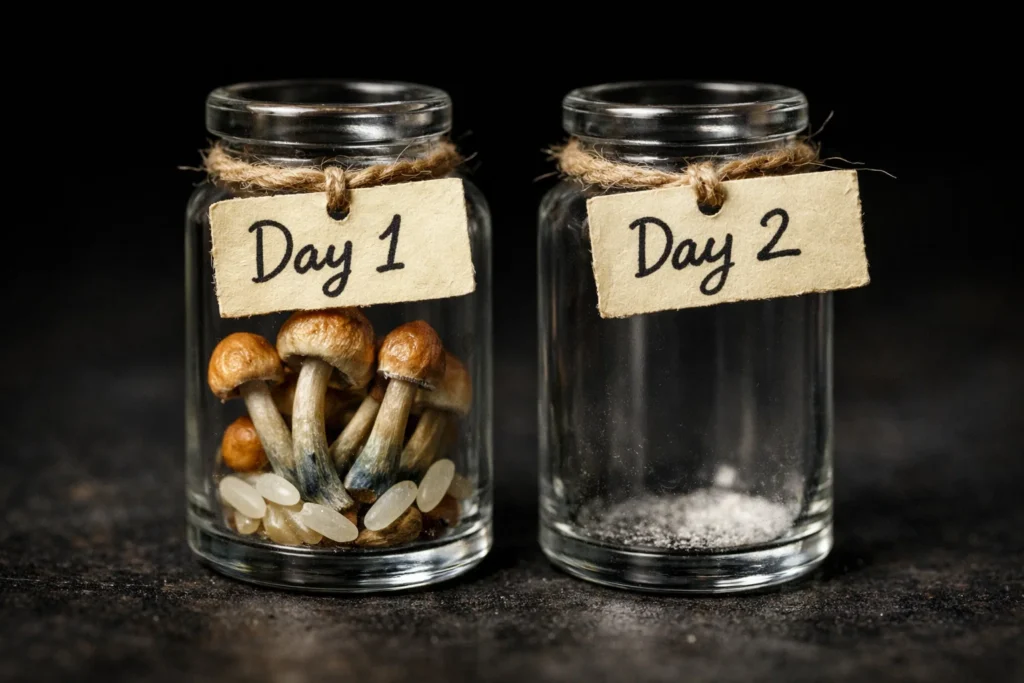
Magic mushrooms can deliver life-changing experiences, but you might be asking: how often is it safe or effective to trip on shrooms? The short answer – not very often. The human body builds mushroom tolerance surprisingly fast. If you take a full psilocybin dose today, taking another the very next day likely won’t work well. Our brains rapidly become less sensitive to psilocybin with repeated use, meaning you’d need a much larger dose after just a few days of back-to-back trips to feel the same effects. In fact, trying to trip multiple days in a row is usually ineffective – by day two or three, the magic just isn’t there.
So why does this happen, and how long do you need to wait for your psychedelic tolerance reset? This article breaks down what psilocybin tolerance is, why it happens (hint: it involves your serotonin receptors), and offers guidance on how often to take shrooms. We’ll also touch on microdosing, since tiny daily doses have their own considerations. By the end, you’ll know why most seasoned psychonauts space out their mushroom journeys – often waiting weeks or even months between trips – and how to schedule your magic mushroom use in a safe, effective way.
Psilocybin tolerance refers to your body’s reduced response to magic mushrooms when you use them repeatedly in a short time. In plain terms, if you take shrooms too frequently, you won’t trip as hard – or at all. Tolerance isn’t unique to mushrooms; it’s a common phenomenon with many substances. But psilocybin (the active compound in shrooms) causes an unusually rapid tolerance buildup compared to many other drugs.
When you ingest psilocybin, your body converts it to psilocin, which interacts with brain receptors to produce psychedelic effects. If you flood your brain with psilocin two days in a row, those receptors quickly adjust and become less responsive. The result: that second trip might feel disappointingly weak or even ineffective. As one drug policy resource notes, “the human body quickly builds tolerance to psilocybin… requiring much higher doses after only a few days of repeated use, making it extremely difficult to have any effect after more than four days of repeated usage”. In other words, shroom tolerance is mostly short-term – it kicks in fast when you use shrooms repeatedly, but (fortunately) it also fades fast once you stop.
It’s important to distinguish tolerance from dependence or addiction. Unlike alcohol or opioids, psilocybin doesn’t cause physical dependence and has a very low addiction potential. People generally can’t trip continuously even if they wanted to – the brain simply “shuts off” the psychedelic effects after a point. This built-in tolerance is one reason magic mushrooms aren’t prone to compulsive daily abuse. Instead, psilocybin is typically self-regulating: an intense trip naturally encourages taking a break afterward, and biologically the tachyphylaxis (rapid tolerance) makes frequent use unrewarding.
The science behind psilocybin tolerance comes down to brain chemistry. Magic mushrooms (like LSD and other classic psychedelics) work primarily by stimulating the 5-HT2A serotonin receptors in your brain. This receptor activation is what causes the hallmark hallucinations, mood shifts, and mind-opening effects. However, these 5-HT2A receptors don’t like to be overstimulated day after day. When you activate them strongly with a psilocybin trip, they respond by temporarily downregulating – essentially dimming their sensitivity to prevent overstimulation.
Think of it like your brain’s safety valve: after a big flood of serotonin-activating psychedelic, the receptors partially shut down for a while. Scientific studies indicate that repeated exposure to psychedelics causes a downregulation of 5-HT2A receptors, which is believed to be responsible for the rapid development of tolerance to psychedelic effects. In simple terms, your brain’s “magic mushroom receptors” go into rest mode after a trip, and no amount of extra shrooms will force them to respond until they reset.
This receptor downregulation is short-term. The receptors gradually return to normal sensitivity over the course of several days to a couple of weeks. That’s why psilocybin tolerance dissipates quickly once you stop dosing. There is no evidence of permanent tolerance from occasional magic mushroom use; it’s really about that brief window after a trip where your brain is in a refractory period. Cross-tolerance also exists between psilocybin and other psychedelics that act on the same receptors. For example, if you take LSD a day after mushrooms, you likely won’t feel much, because LSD is hitting the same 5-HT2A receptors that are still desensitized from the shroom trip. All these substances overlap in how they affect serotonin receptors, so your shroom usage interval needs to account for any psychedelic, not just mushrooms.
The good news is that mushroom tolerance doesn’t last long. Most of the acute tolerance fades within about 5 to 7 days after a psilocybin trip. In fact, sources note that tolerance to psilocybin builds and dissipates quickly – taking it more than about once a week will lead to weaker effects, but after a few days’ break your sensitivity returns close to baseline. Many experienced users follow the rule of thumb to wait at least two weeks between full-dose mushroom trips. One week is often enough for tolerance purposes, but two weeks gives extra buffer and, importantly, allows you time to mentally integrate the experience (more on that in a moment).
In practical terms, if you tripped this weekend, you should probably skip next weekend. Trying to repeat a big trip too soon is usually a waste of good shrooms. As psychedelic author Michelle Janikian puts it, “If you finish a mushroom trip and you try to take mushrooms again [immediately], it won’t work… You can develop a short-term tolerance”. Psychonaut communities widely agree: spacing out your journeys yields far better results than chasing another high the next day.
So, how often can you trip on magic mushrooms? For most people, once a week is too often. Even once every two weeks may be pushing it if you want full effects. A common recommendation is to restrict full psychedelic trips to about once a month at most, or just a few times per year. This kind of schedule ensures each journey is potent and meaningful (and gives you something to look forward to!). In clinical research settings, psilocybin is often administered only once or twice in total, with several weeks in between sessions, because that’s all that is needed to produce lasting therapeutic benefits. In short, less is more when it comes to tripping. Use mushrooms sparingly and they’ll retain their magic.

If you find yourself itching to trip again just days after a big experience, take a step back. Tripping too frequently – like every day or every other day – is not only ineffective biologically, but it might also indicate you’re using psychedelics for the wrong reasons (such as escapism). The psychedelic experience can be emotionally and spiritually intense; doing it repeatedly without break doesn’t give you time to process or apply any lessons from the journey. Moreover, your brain chemistry simply won’t oblige you with another mind-blowing trip so soon. Pushing the issue by upping the dose can lead to wasting mushrooms and could amplify physical side effects without the payoff of a true trip.
Remember that a psilocybin journey is not meant to be an everyday thrill. The afterglow of a good trip can last days or weeks, where you’re still reflecting, learning, and maybe seeing positive changes in your mindset. Lean into that integration period. Use the downtime to journal, make lifestyle adjustments, or talk with friends/therapists about your insights (or what we might call “insights” – those aha moments). If you rush into another trip to chase more visions, you might be running away from doing the real-world work that the last trip opened up for you. Psychedelic veterans often say the real magic is in the integration – taking the time between trips to incorporate what you experienced into your daily life. Good Moods embraces this philosophy of quality over quantity. We encourage our community to journey responsibly and intentionally. It’s telling that even at psilocybin retreats, facilitators will insist on at least a 24-hour break between ceremonies, and many participants go months between big trips.
Lastly, there’s a health consideration: Is it safe to use psilocybin too often? Physically, mushrooms are very low in toxicity and not known to cause organ damage. However, chronic frequent use could, in theory, overstimulate certain serotonin receptors in the heart (5-HT2B receptors) over time. Researchers have noted that while single high doses or widely spaced trips are thought to be safe, very frequent use (e.g. daily or weekly for long stretches) could pose heart valve risks via 5-HT2B activation. This risk is mostly a concern for long-term daily microdosers, but it’s another reason not to push high-dose trips too often.
Bottom line: give your body (and mind) a rest between mushroom experiences. Your heart, brain, and soul will thank you.
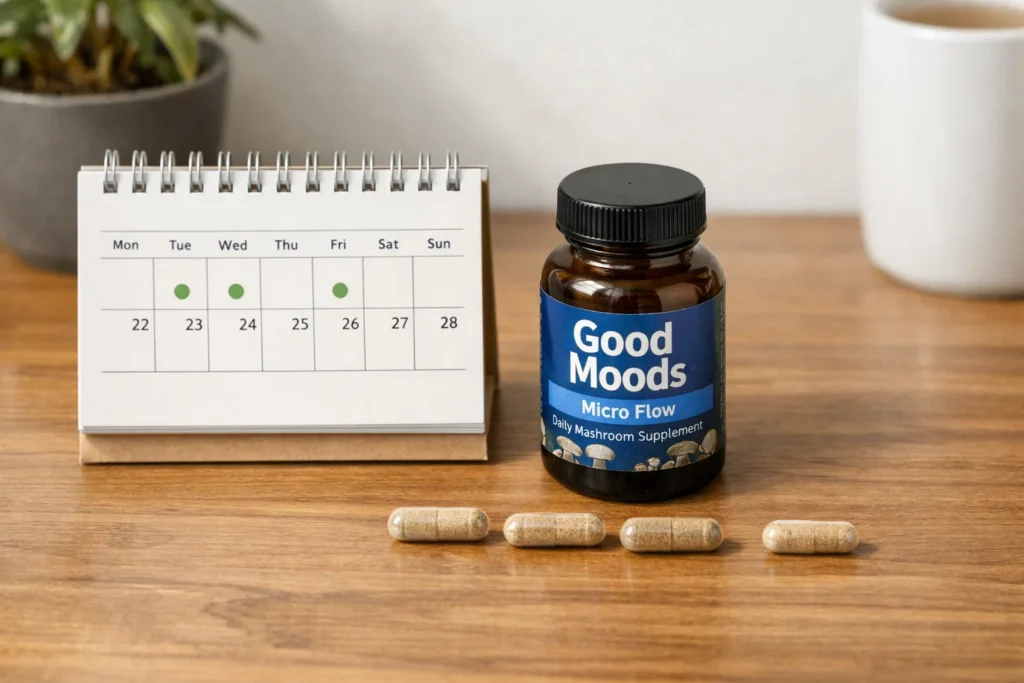
Microdosing – taking a very small, sub-perceptual dose of psilocybin – is a special case. By design, microdoses (often around 0.1g of dried mushrooms, give or take) shouldn’t produce full-blown psychedelic effects. And generally, microdosing on an intermittent schedule does not create significant tolerance. The dose is so low that it lightly tickles those serotonin receptors without blasting them, so your brain doesn’t shut down response in the same way. Many microdosers report they can follow a routine for weeks without noticing tolerance. However, if someone microdoses every single day for an extended period, a mild tolerance could develop, and the effects might diminish.
In fact, popular microdosing schedules explicitly include rest days to prevent tolerance buildup. Two well-known protocols are the Fadiman Protocol (dose on Day 1, then take two days off, repeat) and the Stamets Stack (dose for four days on, then three days off each week). These schedules ensure you’re not continuously activating those receptors without break. If you’re interested in microdosing, check out our guide on microdosing schedules: Fadiman protocol vs. Stamets stack – it breaks down how to cycle your doses effectively (and even discusses stacking psilocybin with other supplements as Paul Stamets suggests).
Most people find that by observing the off-days, tolerance isn’t an issue with microdoses. In one small study, some microdosers reported a slight tolerance over time, while others did not. Anecdotally, many users recommend taking a week or two off after every month or so of microdosing, just to reset completely. Psychedelic researcher James Fadiman noted that after about 30 days of microdosing, many individuals naturally decide to pause – “by 30 days, their system had reorganized enough,” he observed, meaning they felt they got what they needed and further continuous dosing wasn’t providing extra benefit. In practice, a lot of microdosers do a month on, then a break, or they only microdose on certain periods (like work project phases or winter months) and not year-round.
At Good Moods, we produce high-quality microdosing products that are intended to be used responsibly, not every single day indefinitely. For example, our Daytryp Micro Flow Daily Mushroom Supplement (50 capsules) is formulated for consistent, gentle support – but even with a “daily” supplement, you’ll get the best results by following a schedule (such as 5 days on, 2 days off, or another rhythm that suits you). Our microdose capsules are effective enough that you don’t need to take them every day to notice improvements in mood and focus. Likewise, The Good Mood Chews protocol we recommend ensures you enjoy our tasty psilocybin chews while still incorporating regular off-days. The goal is to minimize tolerance and maximize benefits. By spacing out your microdoses, you’ll keep your sensitivity fresh – and you also reduce any theoretical risks from chronic use.
Ultimately, psilocybin tolerance teaches us one thing: patience. Magic mushrooms are best appreciated occasionally, with intention and respect. Instead of trying to trip as often as possible, focus on making each experience count. Here are a few tips for managing tolerance and crafting your personal magic mushroom schedule:
In conclusion, psilocybin tolerance is Mother Nature’s built-in way of saying “take it easy.” Magic mushrooms can be an incredible catalyst for positivity and growth, but they work best when you respect the downtime. Give yourself at least a week (or more) between mushroom trips to let tolerance reset and to integrate what you’ve experienced. If you do microdose, follow a smart schedule with rest days. By pacing yourself, you’ll find that each mushroom experience remains effective, vivid, and worthwhile. Here at Good Moods, we’re here to support responsible use – whether it’s through our educational content or our carefully crafted products that don’t require daily use to make a difference. Enjoy the journey (pun intended) one step at a time, and stay in a Good Mood!
By embracing patience and responsibility, you can enjoy magic mushrooms safely and meaningfully. Whether you’re microdosing for wellness or planning a deep trip, always listen to your mind and body – and when in doubt, give it a little more time. Good vibes await those who respect the magic!
Q: How long should I wait between magic mushroom trips?
A: It’s generally recommended to wait at least one to two weeks between full-dose mushroom trips. Your body needs a few days to reset its tolerance, and a week or more ensures your next trip will be just as potent. In fact, taking shrooms more than once a week can significantly dull the effects. Many seasoned users space their trips about a month apart (or even longer) to allow full psychedelic tolerance reset and give themselves time to integrate the experience.
Q: Can I take shrooms two days in a row?
A: Technically you can, but you probably won’t feel much on the second day. Psilocybin tolerance builds almost immediately after a trip. If you trip today, then try again tomorrow, the second trip will be far weaker even if you increase the dose. After one full dose, your brain’s serotonin receptors need a break and won’t respond the same way right away. Most people who attempt back-to-back shroom days end up disappointed. It’s best to wait several days to a week for the magic to come back.
Q: Does microdosing shrooms every day cause tolerance?
A: Continuous daily microdosing can lead to some tolerance over time, yes. However, if you follow common microdosing schedules with built-in off days (like dosing one day on, two days off), you should avoid significant tolerance. The doses in microdosing are very small, so the impact on tolerance is minimal when managed correctly. Many users report they can microdose for a month and still feel benefits, but even then it’s wise to take a break after ~4 weeks. In short: microdose on a regimen, not every single day indefinitely, and you likely won’t have issues with tolerance.
Q: How often do experienced psychonauts take psychedelics?
A: It varies, but most experienced users treat psychedelic trips as occasional special events, not frequent occurrences. For magic mushrooms, it’s common for people to trip maybe once a month or only a few times per year. Some psychonauts will do a big journey on a meaningful occasion and then not revisit it for several months. This spacing ensures each experience can be profound and valuable (and avoids tolerance). If someone finds themselves wanting to use shrooms too often, they might step back and examine why – because frequent high-dose use is both ineffective and potentially a sign of using mushrooms as escape rather than for positive growth. Remember, with psychedelics, quality of experience beats quantity.