Mushroom Gummies vs Capsules vs Chocolates: Which Is Right for You?
goodmoods23
Magic mushroom products have come a long way from just eating dried shrooms. Today, you can microdose or enjoy psilocybin in tasty gummies, easy-to-swallow capsules, or indulgent chocolate bars. But which format suits you best? In this comparison, we’ll break down the pros and cons of shroom gummies vs capsules vs chocolates – looking at onset speed, taste, dosing precision, and convenience – so you can decide the best mushroom edible for your needs. We’ll also highlight examples from Good Moods’ product line (we offer all three forms) to show how each one shines.
Whether you want a candy-like treat for your dose or a no-frills pill, read on for a mushroom edibles comparison that will help you choose the right format for your microdosing or psychedelic journey.
Onset Speed: How Quickly Each Takes Effect
One key difference between gummies, capsules, and chocolates is how fast they deliver psilocybin’s effects. The form of the product can influence how quickly the active compound is absorbed:
Mushroom Gummies:Gummies may kick in a bit faster than capsules for many people. Why? As you chew a gummy, it starts dissolving in your mouth, allowing some absorption through oral tissues before it even hits your stomach. The sugars and ingredients in gummies digest quickly, so psilocybin can enter your system sooner once swallowed. Many users report that gummies tend to produce first effects on the earlier side of the typical 20–40 minute window after ingestion. This slightly faster onset is similar to how chewable or sublingual supplements act more rapidly than pills.
Magic Mushroom Chocolates: Chocolates are also known for relatively quick onset. Like gummies, a chocolate dissolves as you eat it, and the cocoa butter and sugars help carry psilocybin for absorption. Some anecdotal reports suggest chocolates hit a touch faster than raw mushrooms or capsules, especially if you let the chocolate melt in your mouth. Keep in mind, however, that chocolate contains fats which could slow absorption a bit if you eat a large amount; but with microdose-sized pieces this effect is small. On an empty stomach, a psilocybin chocolate might start taking effect in roughly 20–30 minutes, comparable to gummies. In fact, any form taken on an empty stomach will absorb faster than if you’ve eaten a full meal.
A tasty treat for a relaxed moment – psilocybin chocolates combine your dose with an indulgent experience.
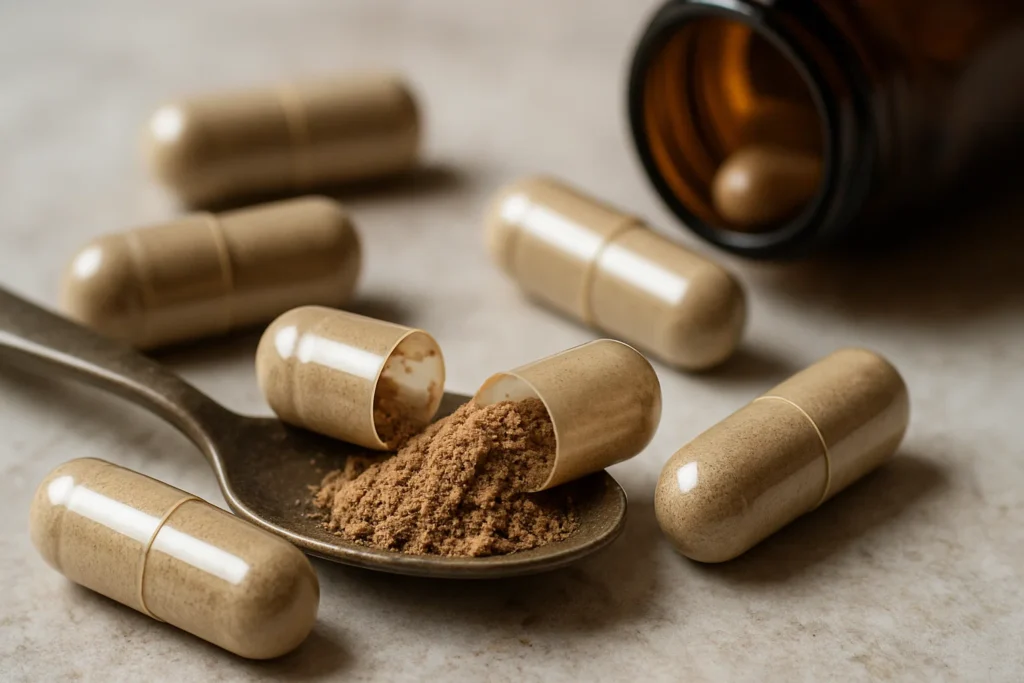
Psilocybin Capsules: Capsules tend to be slightly slower to kick in compared to gummies or chocolates. The capsule shell (often gelatin or a veggie cellulose) must first dissolve in your stomach before the psilocybin inside is released. A standard gelatin capsule typically takes around 10 to 30 minutes to fully dissolve in the stomach. Only then does your body start absorbing the mushroom powder inside. Because of this extra step, the onset may be a bit delayed – often in the 30–60 minute range for noticeable effects, depending on your metabolism and whether you took it with food. If you’re looking for a quick come-up, capsules are slightly slower on average. That said, the difference is not dramatic; you might feel a gummy in 30 minutes vs a capsule in 40 minutes, for example.
Gummies and chocolates can lead to a faster onset than capsules since they begin breaking down in the mouth and are digested as food (with sugars aiding quick absorption). Capsules, which have to dissolve in the stomach, might take a few minutes longer. If timing is critical for you – say you want a dose to kick in quickly – you may prefer the edible formats. On the other hand, all forms will reach peak effects at similar times; the empty vs full stomach factor is usually more significant for onset speed than the form factor itself.
Taste and Palatability: Masking the Mushroom Flavor
Taste is a major reason many people choose mushroom edibles over plain dried shrooms. Magic mushrooms have a very earthy, bitter flavor often described as “like dirt” or raw walnuts – not exactly yummy. Here’s how each format measures up on palatability:
Mushroom Gummies: Taste is arguably where gummies shine the most. A well-made psilocybin gummy completely masks the mushroom taste. Good Mood Chews gummies, for example, come in a delicious Meyer lemon and kumquat flavor – so taking your dose feels like eating a piece of citrus candy, not a mushroom. All the earthy or bitter notes are covered by fruity sweetness. For users who gag on the taste of mushrooms, gummies are a godsend. You’ll simply enjoy a chewy, sweet treat with no hint of mushroom flavor. Plus, there’s no gritty texture; any mushroom extract or powder is thoroughly mixed in the gummy matrix.
Psilocybin Capsules: Capsules have the advantage of being tasteless during consumption – you swallow them whole with water, so you don’t taste anything initially. This is great if you can’t stand any mushroom flavor at all. However, some users report a mild “earthy burp” later on, as the capsule dissolves and the mushroom material digests. In other words, you might experience a slight aftertaste or scent of mushrooms in your burps. This tends to be minor, but it’s something to note if you have a sensitive palate. Overall, capsules spare you the immediate unpleasant taste, though they don’t offer a pleasant taste either (since you don’t taste them at all). It’s a very neutral experience – akin to taking a supplement pill.
Magic Mushroom Chocolates: Like gummies, chocolates mask the mushroom taste completely. High-quality mushroom chocolates taste like…chocolate! The ground mushrooms or extract are blended into rich cocoa, so the dominant flavors are chocolatey sweetness or whatever extra flavors are added (e.g. mint, nuts, etc.). Any earthy or bitter mushroom notes are overwhelmed by the dessert flavors. Many people actually love dosing this way because it feels like treating yourself to a chocolate bar. Good Moods’ Magic Mushroom Chocolates use gourmet ingredients – one of our bars even uses 80-year-old heirloom cacao trees for a premium chocolate experience – so you’d never know there were mushrooms inside except for the effect. If you have a sweet tooth, this format is extremely palatable.
In short, gummies and chocolates offer superior taste by turning your dose into candy. They completely conceal the traditional mushroom flavor and texture, making your experience enjoyable. Capsules are taste-free on ingestion, which is great for avoiding flavor, but you don’t get a yummy treat either (and you might get a mild aftertaste later). If flavor is your top priority – for example, if the thought of mushroom taste makes you cringe – then gummies or chocolates are the clear winners. As one report noted, the unpleasant earthy flavor of shrooms has been a barrier for many, and edibles were developed largely to solve that issue. All three formats spare you from chewing on raw fungi, but only gummies and chocolates turn it into a delicious moment.
Dosing Precision and Consistency
Another important factor for a buyer is how precise and consistent the dosing is with each product type. You want to know exactly how much psilocybin (or mushroom) you’re taking, especially for controlled microdosing. Here’s how the forms compare:
Capsules: Generally, capsules offer excellent dosing precision. Each capsule is typically filled with a measured amount of dried, powdered mushrooms (or an exact milligram dose of psilocybin if it’s an extract capsule). Producers often formulate microdose capsules to a specific weight – for instance, Good Moods offers microdose capsules at 0.32 g of pure mushroom each. This means every pill delivers a consistent microdose. With capsules, it’s very easy to know your dose and to scale up or down by taking more or fewer pills. For example, if one capsule is 0.3 g and you want a ~1 gram dose, you take three capsules – simple! Because capsules are made by filling them with a precise amount of powder, there’s little variation. You can trust that the next capsule will be the same as the last, as long as you buy from a reputable source.
Our Microdose Capsules offer precise, no-frills dosing for a clean and consistent experience.
Gummies: Gummies also can be made with uniform doses per piece. Most vendors label exactly how much mushroom or psilocybin is in each gummy. Good Mood Chews are dosed at 0.25 g of psilocybe Penis Envy mushroom per gummy , ensuring each gummy is consistent. When professionally produced, each gummy in a batch will have the same dose because the extract or mushroom is evenly mixed in the gummy mixture and then molded per piece. This makes dosing straightforward: e.g., 2 gummies = 0.5 g, 4 gummies = 1 g (in the case of 0.25 g each). Commercial psilocybin edibles are designed for consistency – in fact, one of the advantages of formats like gummies is you “know exactly how much psilocybin is in every gummy”, whereas with random dried mushrooms the potency can vary by the piece. As long as you stick to lab-made gummies, dosing is reliable. (Homemade gummies can be trickier to dose evenly, but here we’re focusing on quality store products.)
Chocolates: Mushroom chocolates can offer good dose precision if they are made and divided properly. Most magic mushroom chocolate bars come with a certain total amount of psilocybin and are segmented into squares or sections. For example, you might have a bar containing 3.5 grams of mushrooms in total, divided into 7 squares of 0.5 g each. If the manufacturer homogenized the mushroom extract uniformly in the chocolate, each square should have the advertised dose. Professional products strive for even distribution, so that each piece is consistent. Good Moods chocolates, for instance, are crafted to ensure each breakable square of the bar carries an equal microdose. However, it is worth mentioning that chocolates can be slightly more prone to minor variations if the psilocybin wasn’t mixed perfectly into the chocolate liquor – this was an issue with some artisanal products in the past. Reputable brands mitigate this by thorough blending. The bigger concern is if someone makes their own mushroom chocolates at home: getting an even spread of mushroom in the chocolate can be tricky, leading to “hot spots” (one piece stronger than another). But with store-bought mushroom chocolates, you can generally trust the label. Certain edible forms make dosing easier by pre-measuring each piece, whereas homemade edibles can be harder to gauge.
In summary, all three forms – when produced by a trusted vendor – offer clearly defined doses per unit. Capsules likely give the most exact control (down to the milligram), gummies are also very precise per candy, and chocolates are usually consistent per square (assuming professional manufacturing). Microdosing precision is important; you don’t want surprises. Fortunately, Good Moods provides detailed dosing info on our products: for example, each Good Mood Chew gummy or each Microdose capsule has a fixed amount of psilocybin, so you can dose confidently. If you’re very mathematically minded or titrating carefully, you might lean toward capsules (it’s easier to take 1.5 capsules worth, etc., by splitting a dose). But for most, the difference is minor – it’s easy to count gummies or chocolate pieces too. All formats can be used to microdose (sub-perceptual ~0.1–0.3 g) or to take moderate doses, just by adjusting the number of pieces/pills.
Convenience, Discretion, and Lifestyle Factors
Beyond pharmacology, practical lifestyle considerations might sway your decision. Think about when, where, and how you plan to take your mushroom product. Here’s how gummies, capsules, and chocolates stack up in terms of convenience and discretion:
Capsules: Arguably the most discreet and portable option. Capsules look like any other supplement or medication – you could put them in a pill case or vitamin bottle and no one would be the wiser. They have no odor and no outward sign of being a mushroom product. This makes them great if you need to microdose at work or on the go without drawing attention. Popping a capsule is quick and can be done with a sip of water almost anywhere. Capsules also travel well; they won’t melt or get sticky, and as long as they’re kept dry, they have a long shelf life. Another convenience: no taste to worry about, as discussed, so you don’t need a chaser or snack. For those who value simplicity, capsules are like the no-nonsense choice – no sugar, no flavor, no fuss. They’re also easy to integrate into a supplement routine (you could keep them next to your daily vitamins). Because capsules don’t include sugary ingredients or flavorings, they typically have minimal additives (no artificial colors/flavors), which some health-conscious users prefer. In short, capsules score high for being clean and inconspicuous.
Gummies: Gummies are fun and easy to take, but a bit less discreet. On the plus side, chewing a gummy is a quick, convenient way to dose – you don’t need water, and it might feel like having a light snack. This can make the ritual of microdosing more enjoyable for some (it’s like treating yourself to a candy). Gummies are fairly portable: you can carry a few in a small candy bag or container. However, consider climate and storage – gummies can get soft or melt in high heat. If you toss some in your pocket on a hot day, you might end up with a blob of goo. Good Moods packages our gummies in secure, sealed bags to keep them fresh and avoid sticking. In terms of discretion, eating a gummy could look like you’re just eating candy, which is usually fine – but offering someone else a “gummy” could be problematic if they don’t know it contains psilocybin, so you do have to be mindful. There’s also the sugar factor: gummies do contain sugar and calories, which might be a downside for daily use if you’re watching your intake. Each gummy usually has a couple grams of sugar. While that’s small, it adds up if you take them often. (Most gummy supplements have 2–8g sugar per serving – our Good Mood Chews use organic cane sugar and fruit puree, staying on the lower end of sweetness). If you’re avoiding sweets or have dietary restrictions (e.g. need vegan, note that some gummies use gelatin), capsules might be preferable. Nonetheless, many people find the benefits outweigh the minor drawbacks: gummies are tasty, gentle on the stomach, and still relatively convenient. They’re a great choice if you dislike swallowing pills – compliance tends to be better when people enjoy the form of their supplement.
Chocolates: Magic mushroom chocolates are indulgent and versatile, but with a few practical caveats. A chocolate bar can be broken into microdose pieces, which is handy for adjusting your dose. Eating a piece of chocolate is generally enjoyable and easy. Portability is moderate – a small chocolate bar or a few squares can be carried in a wrapper, but like gummies, they can melt in heat or get messy if not stored properly. Good Moods ships chocolate products with ice packs in summer to maintain integrity (so if you carry chocolate with you, keep it cool and out of direct sun). In terms of discretion, pulling out a branded mushroom chocolate bar might be less discreet than a pill, obviously. However, you could re-wrap it in a regular chocolate wrapper if needed. Eating a bit of chocolate in public is socially normal, but you wouldn’t want anyone unknowingly sampling your special chocolate. From a lifestyle perspective, some people prefer not to have a tempting sweet around – if you’re microdosing frequently, having chocolate bars might challenge your diet if you’re watching sugar. A positive lifestyle aspect: chocolates often contain cacao which has its own mood-lifting benefits (dark chocolate releases endorphins). Some mushroom chocolates even include additional herbs or functional ingredients for synergy, which can be a plus for those who want an all-in-one holistic treat. Like gummies, chocolates contain sugar and fat, so they’re not as “pure” as capsules – something to consider if you have health conditions impacted by diet. The flip side is that the small amount of sugar in a microdose piece is usually quite minimal. As an example, many candy bars have dozens of grams of sugar, whereas a single microdose chocolate square might have just a few grams. Still, if you are very strict about sugar, capsules win out.
To summarize the lifestyle factors: Capsules are the most discreet and maintenance-free (no special storage issues, no added sugars). Gummies and chocolates make your dosing a bit more of a treat and can be easily worked into a routine (who minds an excuse to eat candy or chocolate?), but they do introduce sugars and require more mindful storage (cool, dry place). All three formats are quite convenient in their own ways, so it really comes down to your personal daily habits. If you travel or commute a lot, capsules in a pill case might be easiest to carry. If you dose at home and want to savor the experience, a gummy or chocolate could make it more enjoyable. Also, consider your stomach sensitivity: some people find gummies/chocolate easier on the stomach than capsules, because the mushroom is pre-cooked/processed in the edible (reducing nausea) and the act of chewing can activate digestion gently. In fact, gummies allow some of the absorption to happen through the mouth (bypassing some GI tract hurdles) and often have no “harsh” fillers, making them gentler for those with digestive issues. Capsules, while generally easy to digest, do release raw mushroom powder in your stomach which for some can cause mild nausea until you get used to it. If you have a very sensitive stomach, you might test with a gummy first. On the other hand, if you are avoiding all additives due to sensitivities, a plain capsule with just mushroom might be better than a gummy with various ingredients.
Which One Should You Choose?
As you can see, each format has its own strengths. There is no one “best” choice – it truly depends on your preferences and priorities:
If you hate the taste of mushrooms and want your dose to feel like a treat, gummies or chocolates are perfect. You’ll completely forget you’re consuming mushrooms at all, as you savor the fruity sweetness of a gummy or the rich flavor of a chocolate square.
If you prioritize fast onset and a bit of buccal absorption, gummies (or letting chocolate melt a bit in your mouth) might give you that slight edge in how quickly you feel effects. Capsules might take a little longer on the uptake.
If precision dosing and flexibility are most important, capsules offer the most exact increments. It’s easy to take an exact amount or adjust your dose capsule by capsule. Gummies and chocolates are also consistent per piece, but capsules let you measure doses very finely if needed (and often come in smaller micro amounts).
For discretion and portability, capsules win. They’re stealthy and stable. Gummies and chocolates are a bit more conspicuous and need a bit more care in handling (especially in hot weather).
If you want to avoid added sugars or calories, go with capsules, which typically have none of that. Health-conscious microdosers or those on special diets often prefer capsules for this reason. Conversely, if a little sugar doesn’t bother you and you’d enjoy a candy or chocolate, that may make your routine more pleasant (leading to better consistency in microdosing adherence).
If you don’t like swallowing pills or have trouble with capsules, definitely choose gummies or chocolates. You’ll find it much easier to stick to your regimen when you actually look forward to the form of your dose.
For those with sensitive stomachs, many report that edible formats cause less nausea than straight mushrooms. The act of cooking or extracting mushrooms into an edible can reduce the compounds that cause digestive discomfort. Good Moods customers often choose Good Mood Chews gummies because they are gentle on the stomach and ideal for people with digestive issues who find raw mushrooms hard to handle. Capsules can be fine too – just start with a low dose and perhaps take with a little food if nausea is a concern.
At the end of the day, you can’t go wrong with any of these three – it’s about matching the product to your personal preference. Many customers even like to keep all three on hand for different situations. For example, you might use Microdose Capsules during the workweek for convenience, but enjoy a Good Moods Magic Mushroom Chocolate on a relaxing weekend, or have a gummy when you want a mood-lift treat. Good Moods makes this easy by offering bundles that include gummies, capsules, and chocolates – so you can try them all and see which you love most.
Conclusion
Mushroom gummies vs capsules vs chocolates – the “right” one for you depends on what experience you seek. If you value taste and a fun experience, gummies or chocolates will delight you. If you prioritize precision, discretion, and a sugar-free approach, capsules are your friend. All three will deliver the therapeutic or psychedelic benefits of psilocybin; they just package it differently. Good Moods is proud to offer high-quality Good Mood Chews (gummies), Microdose Capsules, and Magic Mushroom Chocolates – so you have the freedom to choose the form that feels good to you. We even have combo deals so you can experiment with each format. No matter which you pick, rest assured you’re getting a PsiloSafe-certified, precisely crafted product.Now that you know the differences, you can confidently select the mushroom edible that fits your lifestyle. Candy, pill, or chocolate bar – the choice is yours. Happy dosing, and stay Good Mood!
Facebook
Twitter
LinkedIn
You must be 21 years of age or older to make a purchase from this website. All Good Moods plant medicine products are for healing purposes only. Customers agree that any medicines offered on this website are to be used as sacrament to practice your religious beliefs as you wish.