


Magic mushrooms have long been known for their mind-altering effects, but modern science is now uncovering how psilocybin – the key psychoactive compound in these mushrooms – might also influence neuroplasticity. Neuroplasticity is the brain’s ability to rewire itself by forming new neural connections, essentially a form of “brain growth” that underlies learning and adaptation. This has huge implications: from potentially breaking negative thought loops to boosting creativity and mood. In this blog post, we’ll explore how psilocybin affects the brain’s neuroplasticity (the ability for our neurons to reorganize and make new connections). We’ll dive into recent research showing mushrooms can spur neural growth and connectivity, discuss why people often feel a “mental reset” after a psychedelic experience, and consider the roles of microdosing vs. macrodosing in harnessing these effects. Along the way, we’ll keep things accessible with clear metaphors (imagine psilocybin as opening new roads in your brain’s network). And if you’re intrigued by the cognitive benefits of psilocybin, we’ll also touch on why quality and dosing are key – something Good Moods prides itself on with our lab-tested products. Let’s delve into psilocybin, neuroplasticity and whether magic mushrooms can truly “rewire” the brain.

Neuroplasticity (also known as brain plasticity) is the remarkable ability of your brain to change and adapt. It’s how we learn new skills, form memories, and even recover from brain injuries. In simple terms, neuroplasticity means that neural pathways aren’t fixed – your brain’s connections can strengthen, weaken, or re-route based on your experiences. For example, when you practice a new language or instrument, you’re literally rewiring your brain by forming new connections and pathways. Conversely, when certain connections aren’t used, the brain can let them weaken or fade. This constant remodeling is happening all the time, helping you adapt to new situations or break old habits.
However, neuroplasticity can be a double-edged sword. In negative states like depression or PTSD, the brain might reinforce unhealthy pathways – think of it as getting stuck in loops of negative thought patterns. On the flip side, increasing positive neuroplastic changes could help break those loops. This is where psilocybin, the compound in magic mushrooms, is garnering massive interest. Scientists suspect psilocybin can boost neuroplasticity, essentially nudging the brain into a more malleable, receptive state. If true, this could explain why psilocybin therapy has shown promise for conditions characterized by rigid, harmful thought patterns. Let’s look at what research says about mushrooms and brain growth in terms of forming new connections.
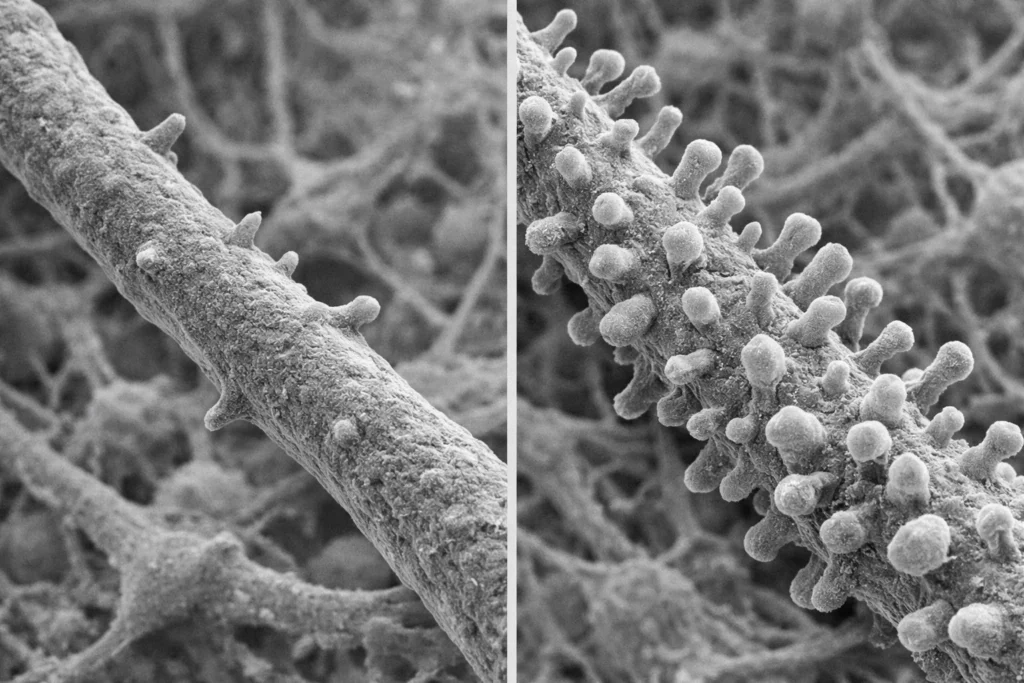
Psilocybin and neural growth: Exciting studies in recent years indicate that psilocybin can indeed spur the brain to form new connections at the cellular level. In one landmark Yale University study, scientists gave a single dose of psilocybin to mice and observed an “immediate and long-lasting increase in the connections between neurons”. In fact, they noted about a 10% increase in the number of neuronal connections, and those new connections were roughly 10% larger (stronger) than before. In other words, the mice brains formed more synapses – the links through which neurons communicate – and those synapses grew in strength. This kind of growth is essentially the brain rewiring itself. The same study also found a rise in dendritic spines density. Dendritic spines are tiny protrusions on neurons where synapses form, often dubbed the “receiving antennas” of nerve cells. By increasing spine density, psilocybin exposure effectively created more docking points for neural communication. Notably, these changes weren’t fleeting – they persisted for a long time (researchers were surprised to find the new neural connections were still present a month later in the mice). It’s as if psilocybin gave the brain’s wiring a growth spurt that endured well beyond the psychedelic experience.
Such findings offer a biological explanation for why people report enduring positive changes after a psychedelic journey. If psilocybin encourages neurons to sprout new connections and strengthen existing ones, the brain may become more efficient at communicating in new ways. One researcher described it vividly: “With psilocybin, it’s like we’re adding all these roads to the brain, but we don’t know where the roads go”. This metaphor comes from Dr. Alex Kwan, a neurobiologist who studies psychedelics’ effects on brain circuitry. Imagine your brain as a map of cities (brain regions) connected by highways (neural pathways). Under psilocybin, new roads open up between regions that usually didn’t interact much. Suddenly, traffic can flow in novel directions. This increased brain connectivity might underlie the creative insights or “thinking outside the box” often reported by psychedelic users. The brain temporarily has more routing options than usual, which could lead to new perspectives and solutions to mental hurdles.
Importantly, these structural changes (more connections and spines) dovetail with other research showing psilocybin’s impact on brain-derived neurotrophic factor (BDNF) and other growth factors that support neural plasticity. In plain terms, psilocybin seems to put the brain in a pro-growth, pro-flexibility mode. It essentially gives your neurons a nudge to reach out and communicate in ways they normally wouldn’t. That’s brain growth not in the sense of increasing brain size, but in forging new neural pathways – which is exactly what neuroplasticity is all about.
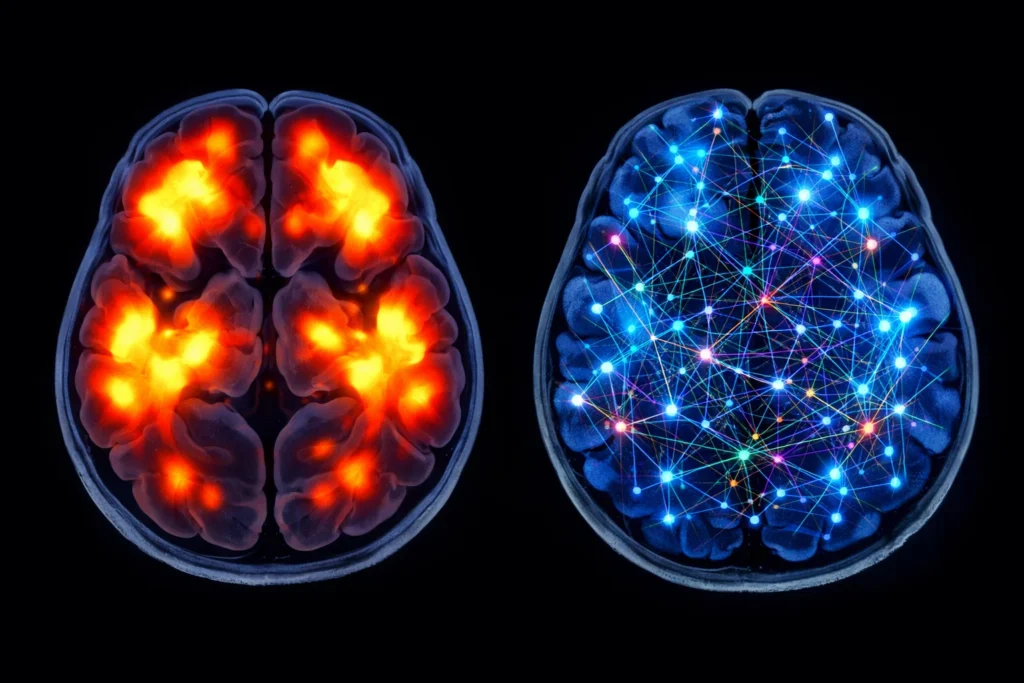
One of the most common subjective reports after a psilocybin trip is the feeling of a “mental reset.” People often describe it as if their brain was “defragmented” or their old thought patterns were shaken loose, providing a fresh perspective on life. This isn’t just hippie folklore – there’s emerging neuroscience to back it. A key player here is the default mode network (DMN), a network of interacting brain regions that is active when our minds wander or ruminate (basically the seat of ego, self-reflection, and habitual thinking). In conditions like depression, the default mode network can be overactive and locked into negative self-talk. Psychedelics appear to disrupt the DMN, offering a chance to break out of those loops.
For example, a 2024 imaging study at Washington University tracked people’s brain activity before, during, and after a high dose of psilocybin. The researchers found that psilocybin “scrambled” the usual communication within the default mode network, temporarily desynchronizing this tightly self-referential circuit. Under the drug’s influence, the normally stable DMN patterns basically fell out of their groove (picture a record player needle skipping). Interestingly, once the acute effects wore off, the network did reform, but it wasn’t exactly the same – small differences persisted for weeks. In essence, psilocybin shook up the system and it didn’t return entirely to its old baseline, which might correlate with lasting psychological changes. As one of the lead researchers put it, “In the short term, this creates a psychedelic experience. The longer-term consequence is that it makes the brain more flexible and potentially more able to come into a healthier state.” In other words, by temporarily dissolving rigid networks like the DMN, psilocybin may allow the brain to reorganize itself in a more optimal way afterward – hence the feeling of a mental reboot.
Another way to visualize this is the “snow globe” analogy. Think of your habitual thought patterns as grooves in a snow globe’s settled snow. Psychedelics come in and shake the globe vigorously – the snow (your thoughts) gets lifted and redistributed. When things settle, you might end up with a whole new pattern instead of the same old ruts. Scientific findings support this metaphor: brain scans show that during a psilocybin trip, regions that seldom talk to each other start communicating, while some usual communication pathways temporarily weaken. It’s as if new bridges form while some old roads close for repairs. This reorganization can manifest as profound insights or the ability to see one’s problems from a new, detached angle. Many users report that after such an experience, they feel as though they’ve “broken out of a cage” of old thinking. Indeed, early clinical studies of psilocybin-assisted therapy for depression find that patients often experience a relief from entrenched negative thought loops – a liberation that traditional treatments sometimes fail to achieve.
It’s important to note that this reset effect doesn’t mean psilocybin magically “fixes” everything permanently. Rather, it opens a window of cognitive flexibility. During that window (which might last days or weeks post-experience), individuals can form new habits, perspectives, and attitudes more easily because the brain is more plastic than usual. This is a crucial point: psychedelics might catalyze change, but the integration – i.e. making use of that flexible period to adopt healthier mental patterns – is key to lasting benefits. That’s why experts emphasize mindful integration practices (like therapy, journaling, or meditation) after a psychedelic journey to cement positive changes in those newly rewired neural pathways.
A big question for enthusiasts is whether you need a full psychedelic trip (a macrodose) to get these brain-rewiring benefits, or if microdosing psilocybin (taking very small, sub-perceptual doses regularly) can also enhance neuroplasticity. Microdosing has become popular among professionals and biohackers who report improved mood, focus, and creativity without the intense hallucinations of a full dose. But what does science say about microdoses and brain growth?
Most of the hard research so far – like the studies we mentioned in mice or the brain scans in humans – has been done with macro doses (a psychedelic dose that causes noticeable tripping). These larger doses clearly induce the dramatic neuroplastic changes (e.g. widespread new connections, network disruption) observed in labs. Microdoses, by contrast, are so small that you typically don’t feel psychedelic effects; they’re often around 1/10 to 1/20 of a full trip dose. There is limited but growing research on microdosing. Early animal studies have hinted that even tiny doses might confer some benefits – for example, one study found microdoses helped conditioned mice overcome a fear response, suggesting facilitated neural adaptability. And many anecdotal reports from microdosers claim that it gradually lifts their depression or helps them break minor bad habits, presumably by subtly promoting a more flexible mindset over time.
That said, scientific consensus on microdosing’s effects is not yet established. It’s possible that microdosing causes milder neuroplastic changes that accumulate with repeated use, but are harder to measure. Some experts theorize that frequent microdosing could gently prime the brain for learning new behaviors (like learning a new skill or coping strategy) by keeping it in a slightly more plastic state. In the community, people often combine microdoses with activities aimed at personal growth – e.g. studying, creative work, or therapy – essentially using the microdose as a nudge towards cognitive enhancement. A well-known example is the “Stamets Stack,” a protocol by mycologist Paul Stamets, which pairs psilocybin microdoses with Lion’s Mane mushroom (a legal medicinal mushroom) and vitamin B3. The goal of that stack is specifically to boost neurogenesis (growth of new brain cells) and brain connectivity. (Fun fact: Good Moods offers a version of this regimen in our 【25†Stamets Stack Microdose / 30 Capsules】, which combines psilocybin, Lion’s Mane, and niacin in one convenient capsule.) While protocols like these are experimental, they show how microdosing enthusiasts are deliberately trying to harness neuroplasticity for self-improvement.
On the other hand, macrodosing (taking a full psychedelic journey dose) is where the most pronounced brain changes have been documented. A single impactful psychedelic experience can be transformative – many users feel as if the “snow globe” of their brain has been shaken and rearranged, as discussed. That kind of deep reset is hard to replicate with microdoses because they don’t provoke the intense network disintegration or mystical experience associated with big doses. Both approaches have their place: Some individuals prefer microdosing as a gentle, ongoing tune-up for mood and cognitive function, while others pursue occasional macrodose journeys for major breakthroughs or emotional release. Interestingly, there’s a middle ground too: “mini-doses” or moderate doses that aren’t full psychedelic trips but are slightly stronger than a microdose – these might produce subtle subjective effects and could also promote neuroplasticity to some degree. Research is ongoing to determine the optimal doses for therapeutic and cognitive outcomes.
Whether one chooses micro or macro, one thing is clear: dosage and purity are key to safely leveraging psilocybin’s brain benefits. Neuroplasticity is a delicate process – you want consistent, predictable dosing to reliably engage those beneficial mechanisms without undue risk or variability. That’s why Good Moods places such an emphasis on quality and accurate dosing in all our products. For instance, our pre-measured microdose capsules (like the Exotic Microdose strains and stacks we offer) ensure you’re getting a precise small amount of psilocybin each time, which is crucial for those incorporating microdosing into their routine for cognitive enhancement. Users have told us that with a consistent dose, they can better tune in to subtle shifts in creativity or focus day by day, whereas uneven homemade doses made it hard to tell what was working.
Likewise, for those interested in a full macrodose experience, quality and consistency matter just as much. The potency of mushrooms can vary widely by strain or cultivation batch. Good Moods addresses this by lab-testing our dried mushrooms (available in various strains by the ounce or pound) so that you can have confidence in how many milligrams of psilocybin you’re actually consuming. This reliability is not only important for safety, but it also contributes to trustworthy outcomes – if you’re aiming to achieve a certain level of introspection or neuroplastic effect, you don’t want a weak dose one time and an overwhelmingly strong dose the next. We provide guidance with our products, whether it’s a micro regimen or a macro journey, to help you match your dose to your goals.
Good Moods is also proud to be PsiloSafe certified (an industry standard for psilocybin product safety and efficacy), meaning we adhere to rigorous quality controls. In the context of brain health, this translates to trustworthiness. If you’re experimenting with psilocybin to potentially boost your neuroplasticity – be it for learning new skills, fostering creativity, or supporting your mental health – you should do so with products that are pure and free of contaminants. All our magic mushroom offerings, from microdose gummies and chocolates to pure fruiting bodies of mushrooms, are handled with that care in mind. This ensures that when you decide to tap into the brain-boosting potential of psilocybin, you’re doing it in the safest, most effective way possible.
On that note, always remember that psilocybin’s legal status varies by region. Good Moods operates in accordance with applicable laws and for educational and therapeutic purposes. Always stay informed about your local regulations and use these substances responsibly.
So, can magic mushrooms rewire the brain? According to a growing body of research and experiential reports, the answer is leaning towards yes – at least to a notable extent. Psilocybin appears to spark neuroplastic changes that few other compounds do, from encouraging neurons to forge new connections and dendritic growth to temporarily breaking down rigid brain network activity (like that of the default mode network). This enhanced flexibility in the brain’s wiring can manifest as what many call a “mental reset,” offering fresh perspectives, emotional breakthroughs, and relief from stubborn negative loops. It’s as if the brain becomes more open to change – more capable of escaping its well-worn ruts and exploring new terrain.
Of course, psilocybin is not a magic bullet or a one-size cure-all. The experience and what you do with it matter greatly. The Experience and Expertise of guides or one’s own preparation can influence outcomes; proper integration (applying insights after the journey) is key to turning transient neuroplasticity into lasting positive change. Scientifically, we are still in the early days of fully understanding psilocybin’s capacity to “rewire” neural circuits. But what is clear so far is that psilocybin can make the adult brain behave more like an adaptable, learning organ again – akin to how a child’s brain is highly plastic. That is an exciting prospect for therapy and personal growth alike.
For those interested in exploring this frontier, trusted sources and sensible approaches are essential. Good Moods is dedicated to providing not just high-quality products (for both microdosing and macrodosing needs), but also education and community support for your journey. Many of our customers have incorporated microdoses into their routine to aid in learning new skills or breaking old habits, essentially leveraging that subtle neuroplastic boost in day-to-day life. Others have taken guided macrodose experiences with our products and reported life-changing shifts in perspective. In all cases, we emphasize safe, informed use – because a healthier, more flexible brain is best achieved when mind, body, and setting are all respected.
Magic mushrooms are showing us that the brain is more capable of change than we ever thought, even well into adulthood. By responsibly tapping into this natural medicine, we might just unlock new levels of mental wellness and cognitive growth. As the science evolves, one thing is certain: the conversation around mushrooms and brain growth has moved from speculative to serious and promising. The roads in the brain that psilocybin opens could lead to many destinations – personal healing, enhanced creativity, spiritual insight, and beyond. We’re excited to be part of this journey, helping you navigate it with knowledge, quality, and trust at every step.
Neuroplasticity is the brain’s ability to reorganize and form new neural connections throughout your life. In simple terms, it means your brain can “rewire” itself based on experiences, learning, or even injuries. This is how you can learn new skills or recover capabilities after brain damage – healthy neurons can take over functions or strengthen pathways to compensate. High neuroplasticity makes the brain more adaptable and is crucial for memory, learning, and habit change.
Research suggests that psilocybin can help “rewire” the brain by promoting neuroplasticity. Studies in animals have shown that a single dose of psilocybin leads to more neural connections and even growth of dendritic spines (small structures that help neurons communicate). In humans, brain scans show psilocybin causes brain networks to rearrange and communicate in novel ways, temporarily breaking old patterns. Subjectively, many people feel like their mind is “reset” after a psychedelic experience. While it’s not a permanent rewiring in one go, psilocybin does seem to make the brain more flexible and open to forming new, healthier connections.
Microdosing – taking very small, regular doses of psilocybin – may confer some neuroplasticity benefits, but the science is still emerging. Anecdotally, many microdosers report enhanced creativity, learning, and ability to break minor habits, which could hint at subtle brain changes. Early research is promising but not conclusive. Microdoses likely produce milder effects than a full psychedelic trip, so any brain changes are smaller and gradual. However, over time, consistent microdosing might gently prime the brain for change. It’s important to approach microdosing with careful, consistent dosing (e.g. using measured products like Good Moods’ microdose capsules) and to note that individual results vary. Large studies are ongoing to determine exactly how microdosing affects neuroplasticity.
The changes in brain connectivity and neural growth induced by psilocybin can be long-lasting but are not necessarily permanent. For instance, increased neural connections and dendritic spines have been observed even weeks after a dose in animal studies. Some alterations in brain network activity (like a re-tuned default mode network) can also persist for weeks to months, which may correlate with sustained improvements in mood or cognition reported by users. However, the brain tends to gradually adjust back towards its baseline over time. Think of psilocybin’s effect as opening a window of heightened plasticity – during that window, lasting positive changes can be made (with therapy, new habits, etc.). But if one returns to the same old lifestyle or thought patterns, the brain may revert to old wiring. In short, psilocybin can kick-start changes, some of which last long, especially if reinforced, but it doesn’t freeze the brain in a new state forever without continued effort or dosing.
To safely explore psilocybin for potential brain benefits, it’s crucial to focus on set, setting, and source. “Set” refers to your mindset – approach the experience with clear intentions and a calm mental state. “Setting” means your environment – choose a safe, comfortable space (and consider having a sober, trusted sitter or guide present, particularly for high doses). Source is extremely important: use only high-quality, tested products from reputable providers. This ensures accurate dosing and purity (no harmful contaminants), so you know exactly how much psilocybin you’re getting. Good Moods, for example, provides lab-tested psilocybin products (from microdose capsules to dried mushrooms) and detailed usage guidelines. Start with a low dose to gauge your reaction. If you’re microdosing, stick to a schedule (such as one day on, two days off) and keep a journal of your experiences. For macrodoses, preparation and integration are key – consider talking to an experienced facilitator or joining a community for support. Always stay informed about the legal status in your area and never drive or do risky activities under the influence. With responsible use, many find that psilocybin can be a valuable tool for personal growth and cognitive flexibility.