

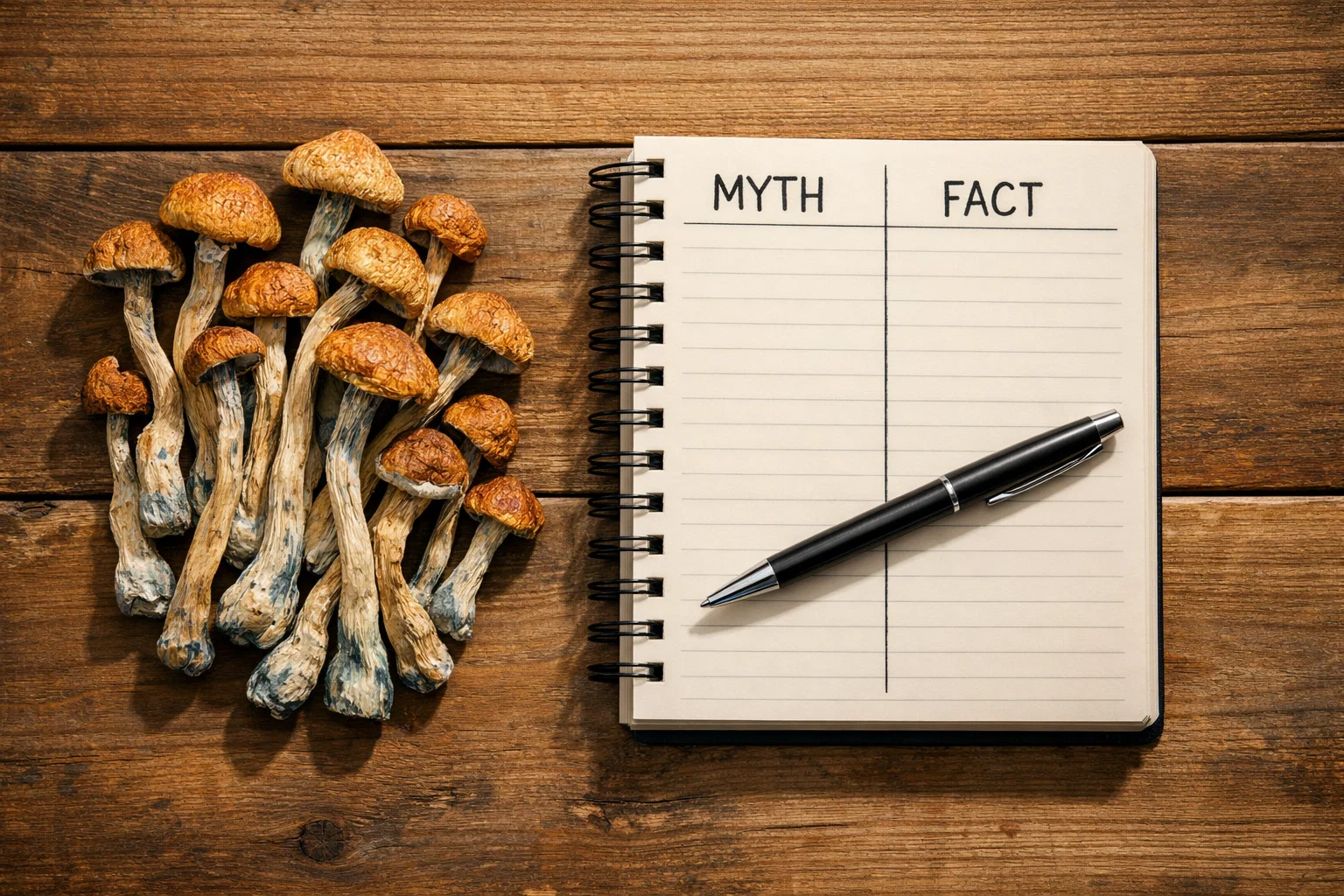
Magic mushrooms (psilocybin mushrooms) have been shrouded in mystery and urban legends for decades. You might have heard people claim things like “Eat shrooms and you’ll go insane forever,” or seen movies where characters trip and literally see dragons. These stories can be pretty scary and confusing! The truth is, many of the frightening things said about psilocybin are myths. We’re here to set the record straight with a friendly, science-backed look at the most common misconceptions. By understanding the facts behind these myths, you can approach magic mushrooms with a clearer head and less unwarranted fear.
Before we dive in, remember that psilocybin – the active compound in “magic” mushrooms – is indeed a powerful substance. Like any psychedelic, it should be treated with respect and used responsibly. Good Moods is dedicated to providing safe, transparent access to these natural tools, so let’s get educated! Below, we tackle each myth one by one, separating fiction from reality.
The Myth: Some folks insist that if you take magic mushrooms, you’ll lose your mind, develop psychosis, or never be the same again mentally. This fear traces back to old anti-drug propaganda suggesting psychedelics cause permanent mental illness.
The Fact: There is no evidence that psilocybin causes lasting psychosis or “insanity” in healthy individuals. In modern clinical research, patients have received controlled doses of psilocybin (often in therapeutic settings) and none have been stuck in a state of psychosis or madness. A recent analysis at NYU found psilocybin did not lead to any lasting paranoia or psychotic symptoms in participants – even those using high doses under medical supervision. In other words, people return to normal once the acute effects wear off.
That said, during a mushroom “trip” it’s possible to feel temporarily out of touch or experience short-lived paranoia – especially if someone takes a very high dose or has an underlying mental health vulnerability. For example, an individual who is predisposed to schizophrenia or other psychiatric disorders could have those conditions triggered or exacerbated by psychedelics. This is why set and setting (your mindset and environment) and personal mental health history are so important. Short-term confusion or panic can occur, but these effects fade as the drug exits your system. They are not permanent changes to your personality or brain. In fact, some population studies even found that people who have used psychedelics tended to have lower rates of serious psychological distress and suicidality than those who hadn’t – though that doesn’t prove cause and effect, it underlines that psychedelics aren’t reliably causing mental breakdowns.
The bottom line is that most healthy users do not develop chronic mental illness from psilocybin. Millions of people have tried magic mushrooms; enduring psychosis is exceedingly rare and usually involves other factors. As long as you’re generally mentally well and you use mushrooms in a safe setting, the idea that they will make you “crazy” for life is a myth. In clinical contexts, psilocybin is even being explored as a treatment for certain mental health conditions, which wouldn’t be happening if it routinely damaged patients’ sanity. Always be mindful of your own mental health, of course – but you don’t need to worry about turning into a permanently psychotic version of yourself just from a mushroom trip.
The Myth: Eat some magic mushrooms, and you’re in for a nightmarish experience – visions of monsters, dragons, and all sorts of terrifying hallucinations. Some people think taking shrooms means you’ll be running from imaginary horrors or stuck in a bad trip, no matter what.

The Fact: Magic mushroom experiences are not automatically scary or hellish. Can a psilocybin trip be scary? Yes – a negative or anxious mindset, or a chaotic environment, can lead to a “bad trip” for some. But it’s just as common (in fact, more common) for mushroom trips to be peaceful, introspective, or even joyful. Many users report feelings of euphoria, deep introspection, laughter, and profound spiritual insight during their journey. A supportive setting – like being with trusted friends or a trained guide in a cozy space – often results in a positive experience rather than a frightening one. Set and setting play a huge role in shaping the trip.
What about seeing dragons or other wild hallucinations? Thanks to movies and urban legends, people imagine psychedelic visuals as completely outlandish – pink dragons flying around, or cartoon characters coming to life. The reality is a bit different. Psilocybin does cause hallucinations, but they are typically distortions of reality rather than totally fabricated fantasy scenes. For example, colors may appear more vivid, you might see patterns or halos around lights, and objects can seem to breathe or warp in shape. If you stare at a textured wall, you might see it flowing like a river. But you’re unlikely to see a fire-breathing dragon materialize out of thin air – that level of imaginary creature is not a common effect of psilocybin. Most visuals are rooted in your actual environment (e.g. a tree might seem to have a face, but you won’t suddenly find a dragon where there is no object at all). There are rare anecdotal reports of people seeing entities or fantastical creatures on extremely high doses, but this isn’t the norm, especially at moderate doses used for personal growth or therapy.
Importantly, people on psilocybin usually recognize that what they’re seeing isn’t real in the normal sense. Psychedelic hallucinations differ from something like a psychotic hallucination because users retain insight – you might think, “Wow, I see geometric shapes and it looks like the walls are melting, but I know it’s the mushrooms causing this.” That insight helps maintain some calm. In contrast, someone with delirium or psychosis might truly believe their hallucination is reality. With mushrooms, you’re generally aware that the odd visuals or amplified emotions are due to the drug’s effects on your perception.
So, no, every trip is not a horror movie. On the contrary, psilocybin sessions in research settings often result in participants describing the experience as one of the most meaningful and positive events of their lives. For example, in one study, a majority of volunteers given psilocybin in a therapeutic setting rated it among their top personal or spiritual experiences ever. While cautionary tales of bad trips get a lot of attention, the positive stories (feeling at peace, connected to nature, experiencing self-love or breakthroughs) are far more common but less sensational to share. By preparing well – choosing the right dose, time, place, and mindset – you stack the deck towards a safe, insightful journey rather than a scary one. And if difficult moments do arise, remember: they are temporary and often manageable with good support (sometimes those challenging moments even lead to valuable personal insights afterward).
The Myth: If you take “too many” magic mushrooms, you could overdose and die, just like with hard drugs. This myth often pops up as a general fear of psychedelics: people treat them like a poison that could shut down your organs or be fatal in high doses.
The Fact: Psilocybin mushrooms have extremely low toxicity in the human body. In plain terms, it’s practically impossible for a human to consume a lethal dose of psilocybin through raw mushrooms. Animal research and toxicology data suggest that the lethal dose of psilocybin is astronomically high relative to an active dose. One scientific review calculated that an average 70 kg (154 lb) person would have to eat around 17 kilograms of dried magic mushrooms in one sitting to approach a lethal dose! That’s an absurd amount – nobody could realistically consume anywhere near that much (17 kg is over 37 pounds of dried shrooms!). For context, a common potent dose is about 3.5 grams dried. So, the gap between an effective dose and a lethal dose is huge, much larger than with many other substances. Physically, psilocybin doesn’t shut down your heart or stop your breathing like opioids or alcohol overdoses can. There have been virtually zero documented deaths from purely psilocybin toxicity alone. In the rare cases someone died during a mushroom-involved episode, it was usually because they did something dangerous while tripping or combined substances – not because mushrooms poisoned them directly.
Now, this is not to say you should go munch a massive amount of mushrooms – taking extremely high doses can definitely lead to other problems (just not organ failure). What can happen if you take way too much is a seriously overwhelming psychological experience. You might become extremely confused, terrified, or detached from reality, which could lead to accidents or injuries. For instance, there have been cases of people on a “bad trip” who, in their panicked state, ran into traffic or injured themselves. The danger with an overdose of mushrooms isn’t that the drug will kill you, but that you might inadvertently harm yourself due to extreme disorientation. That’s why harm-reduction guidelines recommend never tripping in unsafe environments (heights, near busy streets, etc.) and ideally having a sober sitter present if you’re taking a strong dose.
Interestingly, your body has some natural safety mechanisms, too. High doses of psilocybin often cause nausea and vomiting (many users throw up if they’ve eaten a lot of mushrooms). While unpleasant, this actually helps prevent absorbing more toxin if you overindulge. As one medical review put it, a truly lethal overdose is “impractical” because you’d likely vomit up the mushrooms before you could get enough psilocybin into your system to be deadly.
So, can you physically overdose on shrooms and die? Extremely unlikely. You’re far more likely to get sick or have a terrifying few hours than to suffer any lasting physical harm. Of course, any drug taken recklessly can lead to trouble – the real risks of an excessive mushroom dose are psychological distress or unsafe behavior, not your body fatally shutting down. Treat mushrooms with respect, know your dose, and you can stay well within safe limits. Remember: “the dose makes the poison”, and with psilocybin the poisonous dose is so high it’s essentially off the table. Use common sense (don’t chug an enormous unknown quantity of shrooms), and you can confidently cross “fatal overdose” off your list of concerns.
The Myth: One particularly frightening claim is that magic mushrooms make your brain bleed. Some versions say that hallucinations from shrooms are caused by “bleeding in the brain” or that they poke holes in your brain. Yikes! It’s a myth that likely originated from misunderstanding the blue bruising of mushroom flesh (when psilocybin mushrooms are handled or damaged, they often turn bluish – perhaps someone thought that meant they cause “blue bruises” in your head).

The Fact: Magic mushrooms do not cause your brain to bleed. There is no scientific evidence that psilocybin damages brain tissue or causes intracranial hemorrhages. If mushrooms truly made your brain bleed, doctors would have seen clear signs of this in brain scans or autopsies over the years – and they haven’t. On the contrary, modern brain imaging studies on psilocybin show effects like changes in blood flow and connectivity between brain regions, but not physical damage. For example, one fMRI study found psilocybin actually reduced blood flow to certain overactive brain areas (like the default mode network related to ego and rumination). That’s the opposite of causing a hemorrhage. It temporarily alters how neurons communicate (which yields those perceptual changes and “mind-expanding” feelings), but it doesn’t kill neurons or make you bleed. After the drug wears off, brain activity returns to normal baseline. In fact, far from harming the brain, some research suggests psilocybin might promote neuroplasticity, meaning it could help form new neural connections – essentially helping the brain “rewire” in positive ways (researchers are studying this potential to help with depression and other conditions). We delve more into that in our blog post on magic mushrooms and neuroplasticity and how they can “rewire” the brain.
The “brain bleeding” myth might have gained traction because the concept itself is scary and sticky. But let’s put it plainly: taking a normal dose of psilocybin mushrooms does not physically injure your brain. Neurologists and toxicologists who’ve looked at psilocybin classify it as non-neurotoxic. It doesn’t cause the kind of damage that, say, heavy alcohol use does (alcohol can literally kill brain cells and cause brain atrophy over time – and it’s legal!). Psilocybin is even being researched for brain health benefits, such as stimulating growth of neural connections that could help brains break out of rigid, unhealthy patterns. So the only thing “bleeding” from magic mushrooms might be the mushrooms themselves turning blue! The blue bruising you see on a picked psilocybin mushroom is a chemical reaction (oxidation of psilocin), not any kind of blood. There’s no “mushroom blood” and they certainly don’t make your blood leak.
In summary: No, shrooms won’t make your brain bleed. This myth is pure fiction with zero medical backing. You should still use psilocybin responsibly, but you can cross brain bleeding off your list of worries. Your brain’s architecture isn’t being broken by the substance. If anything, under the right conditions, psilocybin might be helping your brain find new, healthier ways to function.
The Myth: Magic mushrooms are drugs, so you’ll get hooked on them and develop an addiction, right? Some assume that because substances like opioids, nicotine, or even alcohol can cause addiction, psychedelics must do the same – leading to cravings and dependence.

The Fact: Psilocybin is not considered addictive in the way that many other drugs are. It does not create physical dependence. Your body doesn’t start needing a psilocybin fix or go into dangerous withdrawal if you stop using it. In fact, current research and official sources (like the National Institute on Drug Abuse) agree that psilocybin does not have addictive properties. Users typically don’t feel a compulsive urge to dose repeatedly; if anything, many people find the mushroom experience so profound or occasionally challenging that they couldn’t (and wouldn’t want to) trip every day even if they tried.
There are a couple of scientific reasons behind psilocybin’s lack of addictiveness. First, it quickly builds tolerance. If you take magic mushrooms on Monday and then again on Tuesday, the Tuesday trip will be significantly weaker even with the same dose. Your brain’s serotonin receptors rapidly down-regulate for a short time. Essentially, the more often you use mushrooms in a short span, the less effect they have, which discourages continuous use. Classic “addictive” drugs tend to do the opposite (think of opioids or nicotine – repeated use makes your body crave more and more). Psilocybin’s effects diminish with frequent use, so there’s no real benefit in taking it over and over in quick succession.
Secondly, psilocybin doesn’t activate the brain’s reward pathways the way addictive drugs do. Substances like cocaine or heroin directly flood the brain’s reward center with dopamine, reinforcing the behavior. Psilocybin works differently; it primarily acts on serotonin receptors and induces introspective or transcendent experiences, not the kind of raw pleasure or euphoria that makes you want to dose again immediately. Many users actually find they need time to integrate what they experienced – taking shrooms can be a big mental journey, and not something you’d want to do habitually every day like coffee or cigarettes.
Now, this isn’t to say someone couldn’t develop a habit or misuse mushrooms. It’s just very uncommon. There’s such a thing as psychological dependence, which can happen with almost any activity or substance (someone could habitually use shrooms as an escape, for example). But from a physiological standpoint, magic mushrooms don’t hook you. In fact, some evidence suggests the opposite: psychedelics have been studied as potential treatments for addiction to other substances, like alcohol and tobacco, because they don’t themselves create a dependency and can prompt insightful changes in behavior.
Official drug surveys back this up: compared to virtually all other recreational drugs, psilocybin has one of the lowest risk profiles for dependence. As one summary puts it, “current research suggests psilocybin is not addictive, and no physical withdrawal symptoms occur after stopping use.”. People who take mushrooms once don’t automatically crave them again – if anything, they usually wait a while before the next journey. So the idea that you try shrooms once and get addicted is a myth. Respect them, yes; treat them like an opioid or meth, no. Your brain isn’t going to start begging for psilocybin in the middle of the night.
The Myth: Any mushroom that has psychoactive effects must be an outlawed substance and inherently dangerous to consume. Basically, “if it gets you high, it’s either banned or it’s poison (or both).” This myth lumps all psychoactive mushrooms together as perilous contraband.
The Fact: This one needs a bit of nuance. It is true that most psilocybin-containing mushrooms are illegal in many countries (they’re classified as Schedule I in the U.S., for example). However, “illegal” doesn’t necessarily equal “physically dangerous,” and conversely not all “legal” mushrooms are safe either! Let’s unpack this.
First, there are some psychoactive mushrooms that are actually legal because they contain different compounds. A great example is the iconic red-and-white Amanita muscaria (fly agaric) mushroom. This is the toadstool from fairy tales – and it can cause hallucinations, but via muscimol (not psilocybin). Amanita muscaria is not a controlled substance in most places; in the U.S. it’s legal to possess in 49 out of 50 states (Louisiana bans it). So a mushroom can “make you high” yet not be outright illegal. Does that mean it’s safe? Not exactly – Amanita muscaria is actually more toxic and unpredictable than psilocybin mushrooms in many ways. It can cause severe nausea, delirium, and even dangerous effects like seizures if taken improperly. So here we have a legal hallucinogenic mushroom that is somewhat dangerous physically. On the flip side, psilocybin mushrooms are broadly illegal, but as we’ve discussed, they are among the least physically harmful recreational drugs known when used responsibly. Extensive studies (including high-dose sessions at universities) have shown that psilocybin, under supervision, is well-tolerated with no serious physiological side effects – no organ damage, no neurotoxicity, and only mild, temporary changes like slightly elevated blood pressure or slight nausea. One safety review of 110 high-dose psilocybin sessions found no medically dangerous events occurred. Researchers even stated that with proper screening and support, psilocybin is “physiologically one of the safest psychoactive compounds studied in modern medicine.” That’s a remarkable statement! It puts in perspective that the level of danger is low compared to many legal substances.
So why are they illegal then? The illegality of psilocybin mushrooms is largely historical and political, dating back to the War on Drugs era, rather than based on an objective risk assessment. (By contrast, something like Amanita muscaria slipped through scheduling laws because it wasn’t part of that 1960s psychedelic scene that lawmakers targeted.) The legal status of psychedelics is actually evolving right now – for instance, cities like Denver and states like Oregon have decriminalized or legalized supervised psilocybin use for adults. This shows a growing recognition that these mushrooms aren’t the “public enemy” they were once made out to be.
In terms of danger: Magic mushrooms can be dangerous if misused – for example, picking wild mushrooms without knowledge can lead to accidentally eating a truly poisonous species (that’s a real danger unrelated to psilocybin itself). Also, doing psychedelics in unsafe situations can lead to accidents (as we noted earlier). And certainly, if someone has certain heart conditions, the temporary rise in blood pressure from psilocybin might pose a risk, so medical screening is advised for clinical use. These are real considerations. But when talking about the intrinsic properties of psilocybin mushrooms: they are non-addictive, very low in toxicity, and do not cause lasting health damage in themselves. “Dangerous” is not a word pharmacologists would apply to psilocybin in a physical sense – the bigger risks are psychological (e.g. a traumatic trip if unprepared) or legal (getting in trouble if you possess them in a strict jurisdiction).
To sum up, it’s a myth that all “magic” mushrooms are illegal everywhere and that they’re inherently deadly. Reality check: There are legal psychoactive mushrooms (with their own risks), and the illegal ones (psilocybin) are actually relatively gentle on the body. Of course, we do not encourage anyone to break the law – always stay informed about your local regulations. If you choose to explore psilocybin where it is permitted, do so with caution and respect. Good Moods, for instance, operates in legal frameworks and offers products like our curated Good Moods Most Popular Bundle for those in areas where use is allowed, ensuring a safe and controlled way to experience these mushrooms. We prioritize lab-tested purity and clear dosing information, so you can feel secure knowing exactly what you’re getting (no misidentified fungi or surprise additives). Responsible use means being aware of both the laws and the best practices for safety.
Whew, we’ve busted a lot of myths! As you can see, magic mushrooms aren’t the boogeyman they’ve been made out to be. They’re not going to rot your brain, turn you into a raving lunatic, or cause instant death. On the contrary, science is finding positive uses for psilocybin – from treating depression to sparking creativity – which is why cultural attitudes and laws are slowly shifting. Of course, responsibility is key. Psychedelics are powerful tools for the mind, and they deserve respect. Being informed is the first step to using them responsibly.
Good Moods is here to be your knowledgeable, caring guide in this space. We love busting myths and sharing facts because an educated community is a safer community. Whether you’re a total beginner curious about microdosing or an experienced psychonaut, our goal is to provide quality products and trustworthy information. We want you to feel comfortable and confident exploring what magic mushrooms have to offer – without the cloud of misinformation.
Good Moods provides a safe, transparent way to do so. Our products are crafted with care, tested for purity, and come with guidance so you know you’re in good hands. If and when you decide to take the next step, we’ll be here to support your journey (no pun intended!) with honesty and heart. Remember, the magic of these mushrooms is best experienced with respect and knowledge. Stay safe and stay curious!
Q1: How safe are magic mushrooms when used responsibly?
A: Magic mushrooms are generally very safe for the body when used responsibly. They have low physiological toxicity – they don’t damage organs and there’s essentially no lethal overdose level in practical terms. Research has shown no serious adverse physical effects in clinical settings using controlled doses. The key risks are psychological and situational. This means that while your body will be fine, your mind can have a rough time if you’re not prepared or you’re in a bad environment. Responsible use involves being in a safe, comfortable setting, in a good mental state, with people you trust. Under those conditions, the vast majority of people handle psilocybin well. It’s also important to avoid mixing mushrooms with other substances that might interact badly. In short, physically speaking, psilocybin is one of the safer psychoactive substances. Just use common sense: dose wisely, and create a safe space for your trip. If you do that, the experience can be not only safe but profoundly positive.
Q2: Can you overdose on magic mushrooms?
A: It’s virtually impossible to fatally overdose on psilocybin mushrooms. Unlike opioids or alcohol, magic mushrooms do not shut down your breathing or heart. The lethal dose is so high that one could never practically eat that many mushrooms at once. In fact, there are no documented deaths from pure psilocybin overdose. If someone takes a very large amount, the danger isn’t from toxicity but from the psychological effects – they might become extremely disoriented or panicked. For example, a person in a confused state could accidentally injure themselves (by wandering into traffic, etc.). Your body will likely purge excess mushrooms by vomiting before anything life-threatening happens. So, while you should not take giant, reckless doses (because a harrowing trip can be traumatic), you can take comfort that a normal dose isn’t going to poison you to death. Always start low, especially if you’re new, to gauge your reaction. Remember: more is not always better with psychedelics.
Q3: Are magic mushrooms addictive?
A: No – psilocybin mushrooms are not considered addictive. They do not create physical dependence, and users typically don’t develop cravings or withdrawal symptoms. After a mushroom experience, most people actually wait a while before doing it again. Interestingly, tolerance to psilocybin builds almost immediately; if you take them on back-to-back days, the second day’s effects will be much weaker. This rapid tolerance makes it self-limiting – there’s no point in using them habitually because the magic won’t be there. Also, mushrooms don’t cause that dopamine “rush” in the brain that addictive drugs do. They tend to be used as occasional tools for insight or therapeutic benefit, not daily kicks. That said, anything can be misused – a person could theoretically become psychologically reliant on the escape mushrooms provide – but this is uncommon. Overall, the risk of addiction with magic mushrooms is extremely low, which is one reason researchers find them promising for treating things like smoking or alcohol addiction (ironically!).
Q4: Do magic mushrooms cause brain damage or long-term mental problems?
A: There is no evidence that psilocybin causes brain damage. It doesn’t “eat holes” in your brain or cause any bleeding or physical injury to neurons. In fact, some studies suggest it might do the opposite – potentially encouraging neural plasticity and positive brain changes. As for long-term mental health issues, in healthy individuals there’s no indication that occasional psychedelic use leads to chronic psychosis or other disorders. The vast majority of people recover fully from the acute effects with no psychological harm. One exception: if someone has a predisposition to a serious psychiatric condition (like schizophrenia or bipolar disorder), a psychedelic experience could potentially trigger an episode of that underlying condition. This is why screening is important in clinical settings. Additionally, a very difficult trip might leave someone shaken in the short term – akin to having gone through an intense emotional event – but with proper integration and support, people usually work through it without lasting trauma. There’s even ongoing research into therapeutic uses of psilocybin for mental health, which would not be happening if it consistently caused mental health deterioration. So, taken responsibly, mushrooms are not going to fry your brain or make you permanently crazy. Always respect set and setting to protect your mental well-being during the experience, but you can be reassured that psilocybin isn’t physically eroding your mind.